A Hydraulic Flow Control Valve is the primary tool for managing the speed of a hydraulic cylinder. By regulating the volume of fluid that enters or exits the cylinder, it allows operators to fine-tune the velocity of the piston rod for a wide range of applications. However, achieving precise speed control requires more than simply turning a knob. It demands a systematic approach that accounts for the valve type, the load conditions, and the specific requirements of the hydraulic circuit.
This guide provides a comprehensive, step-by-step methodology for adjusting a Hydraulic Flow Control Valve to achieve precise cylinder speed control, covering everything from safety preparations to advanced troubleshooting.
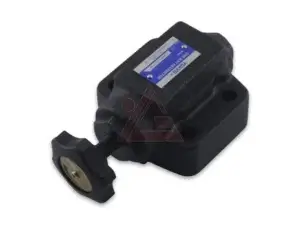
1. Understanding Flow Control Methods: Meter-In vs. Meter-Out
Before making any adjustments, it is critical to understand how the Hydraulic Flow Control Valve is integrated into the circuit. The placement determines the control strategy.
Meter-in control involves placing the Hydraulic Flow Control Valve on the inlet side of the cylinder, restricting the flow of fluid entering the actuator. This method is typically used when the load opposes the direction of movement (e.g., a cylinder lifting a heavy load). When adjusting a meter-in circuit, the valve controls the oil going to the cylinder.
Meter-out control involves placing the Hydraulic Flow Control Valve on the outlet side, restricting the flow of fluid leaving the cylinder. This method provides better control for overrunning loads where the load tends to pull the cylinder (e.g., a cylinder lowering a load). When adjusting a meter-out circuit, the valve controls the oil leaving the cylinder.
2. Safety and Preparation
Safety is paramount when working with hydraulic systems. Before adjusting any Hydraulic Flow Control Valve, follow these critical steps:
Depressurize the system: Cycle all control valves to release trapped pressure.
Lock out/Tag out: Follow proper lockout/tagout procedures to prevent accidental system startup.
Wear PPE: Use safety glasses, gloves, and protective clothing.
Reach operating temperature: Hydraulic oil viscosity changes with temperature, which affects flow control accuracy. For consistent results, adjust the valve only after the system has reached its normal operating temperature (typically 100°F to 140°F).
3. Basic Adjustment Procedure for a Standard Flow Control Valve
The following general procedure applies to most manually adjustable Hydraulic Flow Control Valves.
Step 1: Identify the Valve and its Direction
Locate the valve and identify its adjustment mechanism (knob, screw, or handle). Most valves have a cast arrow indicating the direction of flow. Installing the valve backwards will prevent proper operation.
Step 2: Loosen the Lock Nut (if equipped)
Many valves have a lock nut that secures the adjustment screw. Loosen this nut to allow for adjustment.
Step 3: Make Incremental Adjustments
Using a wrench or screwdriver, turn the adjustment screw:
Clockwise generally decreases flow, slowing the cylinder speed.
Counterclockwise generally increases flow, increasing the cylinder speed.
Make small adjustments (e.g., 1/4 turn) and observe the cylinder’s speed.
Step 4: Test and Fine-Tune
Cycle the cylinder through several full strokes. If the speed is too fast, reduce the flow; if too slow, increase the flow. Continue this process of small adjustments and testing until the desired speed is achieved.
Step 5: Lock the Setting
Once the desired speed is achieved, tighten the lock nut while holding the adjustment screw in place to secure the setting.
Step 6: Verify and Inspect
After final adjustment, run the cylinder through several more cycles to confirm the setting is stable. Recheck all connections for leaks.
4. Adjusting Pressure-Compensated Flow Control Valves
A pressure compensated flow control valve is designed to maintain a constant flow rate regardless of pressure variations, ensuring consistent cylinder speed under varying loads. This makes it ideal for applications with fluctuating system pressure.
Key Adjustment Considerations:
Maintain Minimum Differential Pressure: For accurate pressure compensation, ensure there is a minimum pressure drop across the valve, typically around 200 psi (14 bar).
Direction of Adjustment: The regulated flow of a pressure-compensated valve increases with counter-clockwise adjustment rotation (though some models may be opposite, so always consult the manufacturer’s documentation).
Balanced Adjustment: Many pressure-compensated valves feature a balanced adjustment mechanism, allowing for easy adjustment even at high pressures.
5. Adjusting Needle Valves for Speed Control
A needle valve is a simple, adjustable Hydraulic Flow Control Valve that uses a tapered needle to restrict flow. While cost-effective, they are sensitive to fluid viscosity changes and pressure fluctuations.
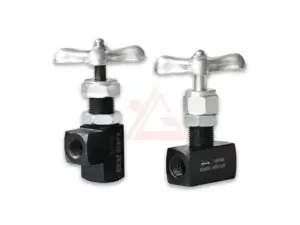
Adjustment Method:
- Start with the needle valve in the closed position.
- Gradually open the valve by turning it counterclockwise.
- Test the cylinder speed and make small adjustments.
- Caution:Opening the valve too quickly can cause sudden actuator movement.
6. Advanced Adjustment: Using a Flow Meter
For the most precise adjustment, use a flow meter. This is the recommended method for critical applications.
Procedure:
- Install a flow meter in-line on the controlled flow port(s) on the outlet of the valve.
- Adjust the valve until the flow meter reads the specified flow rate for the application.
- Lock down the setting and repeat the test to verify the setting is still correct.
7. Common Mistakes to Avoid
Adjusting at the wrong temperature: Always adjust the valve at the system’s normal operating temperature.
Making large adjustments: Always make small, incremental adjustments and test the system.
Failing to depressurize the system: Never adjust or disconnect a valve under pressure.
Forgetting to lock the adjustment: Always secure the lock nut after adjustment.
Ignoring the load: Consider the load when choosing between meter-in and meter-out control.
Conclusion
Achieving precise cylinder speed control requires a thorough understanding of the Hydraulic Flow Control Valve, the specific circuit (meter-in vs. meter-out), and the load conditions. Whether you are adjusting a standard flow control, a pressure compensated flow control valve, or a simple needle valve, the key to success lies in a systematic approach: prioritize safety, make small adjustments, and always test the system. For the highest precision, using a flow meter is the recommended best practice. By following the steps outlined in this guide, you can master the art of hydraulic speed control, ensuring your equipment operates with optimal efficiency and reliability.