A Hydraulic Gear Pump is one of the most widely used hydraulic pumps across industries, but not all gear pump designs are the same. Understanding the different types of gear pump available is essential for selecting the right pump for your hydraulic system. In this comprehensive guide, we will explore the various types of Hydraulic Gear Pump, their working principles, key features, applications, and how to choose the right one for your needs.
1. What Is a Gear Pump?
Before exploring the different types, it is important to understand what a gear pump is. A Hydraulic Gear Pump is a positive displacement pump that uses the meshing of gears to pump fluid by displacement. It is one of the most common types of Hydraulic Gear Pump due to its simple construction, high reliability, and cost-effectiveness. The gear pump operates by trapping fluid between the gear teeth and the pump housing, then carrying it from the inlet to the outlet under pressure.
2. External Gear Pumps
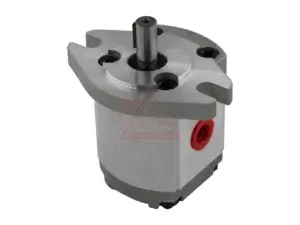
The external gear pump is the most common type of Hydraulic Gear Pump used in industrial and mobile applications. It uses two identical gears of the same size that mesh externally. One gear is the drive gear, and the other is the driven gear. As they rotate, fluid is trapped between the gear teeth and the pump housing, then carried from the inlet to the outlet.
How It Works
The drive gear rotates, which causes the driven gear to rotate in the opposite direction. As the gears rotate away from the inlet port, a vacuum is created, drawing fluid into the pump. The fluid fills the spaces between the gear teeth and is carried around the outside of the gears to the outlet side. As the gears mesh together, the fluid is displaced and forced out through the outlet port.
Applications
External gear pumps are widely used in:
Construction equipment
Agricultural machinery
Material handling systems
Industrial manufacturing
Advantages
Simple and robust construction
High reliability and durability
Cost-effective
Self-priming capability
Tolerant to contamination
Disadvantages
Fixed displacement only
Can be noisy at high speeds
Less efficient at very high pressures
3. Internal Gear Pumps
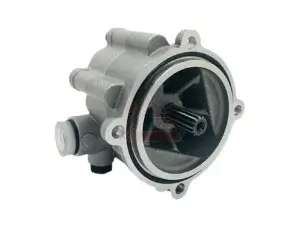
The internal gear pump is another important type of Hydraulic Gear Pump. It uses one larger gear with internal teeth and a smaller external gear that rotates inside it. The fluid is trapped between the gear teeth and a crescent-shaped separator.
How It Works
The internal gear pump operates on the same basic principle as the external gear pump, but with a different geometry. The smaller external gear rotates inside the larger internal gear. A crescent-shaped separator fills the space between the gears, ensuring fluid is carried from the inlet to the outlet.
Applications
Internal gear pumps are commonly used in:
Industrial machinery
Machine tools
Hydraulic power units
Lubrication systems
Advantages
Quieter operation
Better suction capabilities
Can handle a wide range of fluid viscosities
Longer service life
Disadvantages
More expensive than external gear pumps
More complex construction
More sensitive to contamination
4. Gerotor Pumps
A gerotor pump is a specific type of Hydraulic Gear Pump that uses an inner rotor and an outer rotor. The inner rotor has one fewer lobe than the outer rotor. As the rotors rotate, the volume between the lobes changes, drawing in and discharging fluid.
How It Works
The inner rotor is driven by the power source and rotates eccentrically inside the outer rotor. The difference in the number of lobes creates varying chamber volumes. Fluid is drawn into the expanding chambers and expelled as the chambers contract.
Applications
Gerotor pumps are commonly used in:
Automotive oil pumps
Aerospace applications
Small hydraulic systems
Lubrication systems
Advantages
Compact design
Quiet operation
Good efficiency
Excellent suction capabilities
Disadvantages
Lower pressure capability
Tighter clearances required
More sensitive to wear
5. Screw Gear Pumps
While technically a type of gear pump in the broader sense, screw pumps use one or more screws to move fluid along the axis of the screws. They are positive displacement pumps that provide smooth, pulsation-free flow.
Applications
Screw pumps are typically used in:
Marine applications
Oil and gas industry
Large industrial systems
High-flow applications
Advantages
Very quiet operation
Smooth, pulsation-free flow
Can handle a wide range of fluids
Excellent suction capabilities
Disadvantages
Expensive
Large size
Requires precise manufacturing
6. Fixed Displacement Gear Pumps
A fixed displacement gear pump is a Hydraulic Gear Pump that delivers a constant volume of fluid per revolution, regardless of pressure. The flow rate can only be changed by altering the pump speed.
Applications
Fixed displacement gear pumps are used in:
Constant flow applications
Open center hydraulic systems
Mobile equipment
Simple hydraulic circuits
Advantages
Simpler construction
Lower cost
High reliability
Easy to maintain
Disadvantages
Wastes energy when flow demand varies
Cannot adjust to load requirements
7. Variable Displacement Gear Pumps
Unlike fixed displacement pumps, a variable displacement Hydraulic Gear Pump can adjust its output flow to match system demand. While less common than variable displacement piston pumps, variable displacement gear pumps exist in specialized designs.
Applications
Variable displacement gear pumps are used in:
Systems with varying flow requirements
Energy-efficient hydraulic systems
Specialized industrial equipment
Advantages
Energy efficient
Matches flow to demand
Reduces heat generation
Disadvantages
More complex
More expensive
Less common
8. How to Choose the Right Gear Pump Type
Selecting the right type of gear pump for your application requires careful consideration of several factors:
Pressure Requirements: External gear pumps handle higher pressures than gerotor pumps.
Flow Rate: Calculate the flow needed for your actuators.
Speed: Match the pump speed to your power source.
Noise Constraints: Internal gear pumps and gerotor pumps are quieter.
Fluid Viscosity: Internal gear pumps handle wider viscosity ranges.
Cost: External gear pumps are the most cost-effective option.
9. Common Applications by Pump Type
| Pump Type | Common Applications |
|---|---|
| External Gear Pump | Construction, agriculture, material handling |
| Internal Gear Pump | Industrial machinery, machine tools |
| Gerotor Pump | Automotive, aerospace, lubrication |
| Screw Pump | Marine, oil and gas, large industrial |
Conclusion
Understanding the different types of Hydraulic Gear Pump is essential for selecting the right pump for your application. External gear pump designs offer simplicity and economy for most general applications. Internal gear pump provides quieter operation and better suction. Gerotor pump offers compact design for specialized applications. Screw pump delivers smooth, pulsation-free flow for high-flow systems. By understanding the differences between these gear pump types, you can make an informed decision and ensure reliable, efficient operation for your hydraulic system.