A Tie Rod Hydraulic Cylinder is a versatile and widely used linear actuator, but its performance and longevity depend heavily on correct mounting. Choosing the right mounting style ensures proper alignment, minimizes side loads, and maximizes service life. In this guide, we will explain the most common mounting styles for a Tie Rod Hydraulic Cylinder, their typical applications, and key selection criteria. For a basic understanding of this cylinder type, refer to our guide on What Is a Tie Rod Hydraulic Cylinder?.
1. Why Mounting Style Matters
The mounting style determines how a Tie Rod Hydraulic Cylinder is attached to your machine. An incorrect mount can cause bending stress, seal damage, and premature failure. Proper mounting keeps the cylinder axially aligned with the load, allowing the piston rod to extend and retract smoothly. Whether you need a heavy duty tie rod cylinder or a compact tie rod cylinder, selecting the right mount is critical.
2. Fixed Mounts – MS2, MS4, MS7 (Clevis Mount)
Clevis mounts use a U-shaped bracket and a pin to attach the cylinder. Common NFPA clevis styles include:
MS2: Side lug mounted clevis.
MS4: End cap mounted clevis.
MS7: Rod end clevis (on the piston rod).
A clevis mount allows a small amount of angular movement, making it suitable for applications where the load swings or pivots. A tie rod cylinder with clevis mount is often found in construction equipment, material handling, and agricultural machinery.
3. Fixed Mounts – MF1, MF2, MF3, MF4 (Flange Mount)
Flange mounts use a rectangular or square flange bolted to the machine structure. Types include:
MF1, MF2: Head end flange (cap side).
MF3, MF4: Rod end flange.
Flange mounts provide rigid, zero-misalignment attachment. They are ideal for applications with precise axial loading, such as presses and machine tools. A high pressure tie rod cylinder with a flange mount can handle high thrust forces without bending.
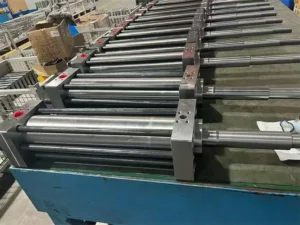
4. Fixed Mounts – MP1, MP2, MP3, MP4 (Side Lug Mount)
Side lug mounts have two lugs extending from the cylinder body (either head end, cap end, or both). These lugs are bolted to a flat surface. MP mounts are common in industrial automation and conveyor systems. A standard tie rod cylinder with side lugs is easy to align and replace.
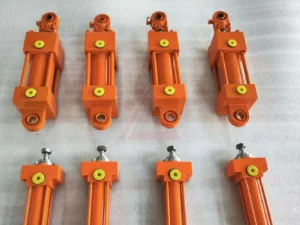
5. Pivot Mounts – MT1, MT2, MT3, MT4 (Trunnion Mount)
Trunnion mounts use pins perpendicular to the cylinder axis, allowing the cylinder to pivot in one plane. Styles:
MT1, MT2: Head end trunnion.
MT3, MT4: Intermediate trunnion (mounted at the middle).
Trunnion mounts are essential for applications where the cylinder must rotate as it extends, such as in dump truck hoists or scissor lifts. A double acting tie rod cylinder with trunnion mount provides smooth articulation.
6. Rod End Accessories – Clevis, Eye, Threaded Stud
Besides the cylinder body mounting, the rod end can have various attachments:
Clevis and pin: For pivoting connections.
Threaded stud: For direct coupling.
Eye (spherical bearing): Allows misalignment.
These rod end options work with any Tie Rod Hydraulic Cylinder and are often specified together with the main mount. A custom tie rod cylinder can combine a trunnion body with a clevis rod end.
7. How to Choose the Right Mounting Style
Consider these factors when selecting a mount for your Tie Rod Hydraulic Cylinder:
Load direction: Is the force purely axial or does it include side load?
Machine structure: What flat surfaces or brackets are available?
Movement required: Does the cylinder need to pivot during extension?
Space constraints: Flange mounts are compact; side lugs require more width.
For applications with no side load, any rigid mount (flange or side lug) works. For pivoting needs, choose clevis or trunnion. A repairable tie rod cylinder allows you to change the mounting style by swapping end caps – a major advantage.
8. NFPA Mounting Code Interchangeability
All the mounts described follow NFPA (National Fluid Power Association) dimensional standards. This means a Tie Rod Hydraulic Cylinder from one manufacturer with a specific mount code (e.g., MP2) will have the same bolt hole pattern and dimensions as another brand’s MP2 cylinder. This interchangeability simplifies replacement and reduces downtime.
9. Common Mistakes to Avoid
Using a fixed mount where pivoting is needed – causes rod bending.
Ignoring side load – leads to seal failure and scoring.
Misalignment between cylinder and load – reduces life dramatically.
Overtightening mounting bolts – distorts the cylinder barrel.
Always consult the manufacturer’s mounting guidelines for your specific Tie Rod Hydraulic Cylinder.
10. Application Examples by Mounting Style
Flange mount (MF): Hydraulic press, injection molding machine – rigid, high force.
Side lug mount (MP): Conveyor drive, transfer station – easy alignment.
Clevis mount (MS): Forklift tilt cylinder, excavator linkage – allows pivot.
Trunnion mount (MT): Dump truck hoist, aerial lift – full articulation.
Rod end eye: Cylinder with spherical bearing for misaligned loads.
Conclusion
Choosing the correct mounting style for a Tie Rod Hydraulic Cylinder ensures reliable operation, long seal life, and safe machine performance. From clevis and flange to side lug and trunnion, each style serves a specific purpose. Whether you need a heavy duty tie rod cylinder, compact tie rod cylinder, high pressure tie rod cylinder, standard tie rod cylinder, double acting tie rod cylinder, or repairable tie rod cylinder, matching the mount to your application is essential. For foundational knowledge, revisit What Is a Tie Rod Hydraulic Cylinder?. Always follow NFPA guidelines and manufacturer recommendations when selecting and installing mounts.