Not every hydraulic application calls for the same cylinder design. Among the most popular options is the Tie Rod Hydraulic Cylinder, known for its ease of maintenance, standardized dimensions, and cost-effectiveness. But when is it the right choice? Understanding the strengths and limitations of a Tie Rod Hydraulic Cylinder helps engineers and maintenance professionals make informed decisions. In this guide, we will outline the specific conditions and applications where a Tie Rod Hydraulic Cylinder outperforms other designs. For a detailed explanation of its construction, see our guide on What Is a Tie Rod Hydraulic Cylinder?
1. When Easy Maintenance Is a Priority
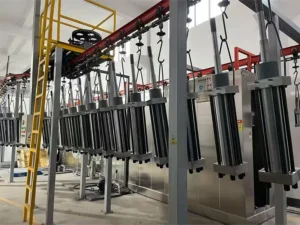
One of the strongest reasons to choose a Tie Rod Hydraulic Cylinder is serviceability. The external tie rods can be unbolted, allowing full access to internal seals, wear rings, and bearings without cutting or welding. This makes it ideal for factories and workshops where routine rebuilding is part of the maintenance schedule. A repairable tie rod cylinder can be rebuilt multiple times, extending its life at a fraction of replacement cost.
2. When You Need NFPA Interchangeability
Most Tie Rod Hydraulic Cylinder manufacturers follow NFPA (National Fluid Power Association) dimensional standards. This means cylinders from different brands with the same bore, stroke, and mounting style are mechanically interchangeable. If you have an existing machine with NFPA-standard mounts, a standard tie rod cylinder will fit perfectly without adapter plates or modifications. For global operations, this interchangeability simplifies spare parts management.
3. When Cost Efficiency Matters
Compared to welded or mill-type cylinders, a Tie Rod Hydraulic Cylinder is generally less expensive to manufacture and purchase. Mass production and standardized components drive down cost. For applications that do not involve extreme shock loads or severe side loading, the tie rod design offers excellent value. A heavy duty tie rod cylinder provides robust performance at a lower price than a custom welded unit.
4. When Operating Pressures Are Moderate
A Tie Rod Hydraulic Cylinder is typically rated for pressures up to 3,000 psi (210 bar), though some heavy-duty versions can go higher. If your system operates within this range, a tie rod cylinder is a safe and reliable choice. For higher pressures (e.g., 5,000 psi or more), a welded or mill-type cylinder may be required. However, for most industrial machinery, a high pressure tie rod cylinder designed with thicker rods and upgraded seals will suffice.
5. When You Need a Double Acting Cylinder
Most tie rod cylinders are configured as double acting tie rod cylinder units – they have ports on both ends, allowing powered extension and retraction. This makes them suitable for applications such as clamping, lifting, pressing, and material handling where controlled motion in both directions is required. A single acting tie rod cylinder (pressure only on one side) is also available but less common.
6. When Space Is Not Extremely Tight
Because the tie rods run externally, a Tie Rod Hydraulic Cylinder has a larger footprint than a welded cylinder of the same bore and stroke. If your machine has ample mounting space, this is not an issue. For compact equipment or mobile machinery where every inch counts, consider a welded design. However, for stationary industrial equipment, the compact tie rod cylinder (with shorter tie rods) still fits most envelopes.
7. When Side Loading Is Minimal
Tie rod cylinders are not designed to handle significant side loads. The rods can stretch or bend under uneven forces. If your application involves perfect axial alignment (e.g., a press guided by linear bearings), a Tie Rod Hydraulic Cylinder will perform well. For applications with unavoidable side forces (e.g., excavator buckets), a mill-type or welded cylinder is better.
8. When You Require Standard Seal Kits
One practical advantage of a Tie Rod Hydraulic Cylinder is the wide availability of seal kits. Because dimensions are standardized, you can buy a replacement seal kit for tie rod cylinder from multiple suppliers. This reduces downtime – no waiting for custom seals. For plants with many different machines, standardizing on tie rod cylinders simplifies inventory.
9. When You Plan to Do In-House Repairs
If your maintenance team prefers to rebuild cylinders on-site, a Tie Rod Hydraulic Cylinder is the best choice. Disassembly requires only basic hand tools and a torque wrench. A custom tie rod cylinder with special porting may still be rebuildable using standard seal kits. This capability is especially valuable for remote locations or industries with tight repair budgets.
10. When You Need a Reliable General-Purpose Cylinder
For countless industrial tasks – clamping in a fixture, feeding a conveyor, lifting a table – the Tie Rod Hydraulic Cylinder is the proven workhorse. It balances cost, performance, and maintainability. Whether you need a small tie rod cylinder for light duty or a large tie rod cylinder for heavy pressing, this design delivers consistent, long-lasting service.

Conclusion
Choose a Tie Rod Hydraulic Cylinder when you value easy maintenance, NFPA interchangeability, cost efficiency, moderate pressures, double-acting functionality, ample space, minimal side loading, standard seal kits, in-house repairability, and general-purpose reliability. Understanding these conditions ensures you select the right actuator for your machine. For a deeper look at the construction and working principle, revisit What Is a Tie Rod Hydraulic Cylinder?When the application fits the tie rod profile, you gain a dependable, economical, and service-friendly solution