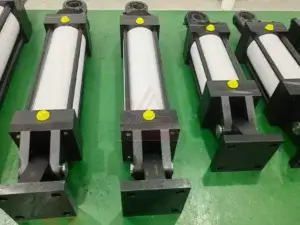
When standard off-the-shelf options do not fit your machine’s dimensions, performance requirements, or environmental conditions, a custom Tie Rod Hydraulic Cylinder is the solution. Specifying a custom cylinder correctly ensures perfect fit, reliable operation, and long service life. In this guide, we will walk you through the key parameters you must define when ordering a custom Tie Rod Hydraulic Cylinder. For a basic understanding of this cylinder type, refer to our guide on What Is a Tie Rod Hydraulic Cylinder?.
1. Define Bore Size and Rod Diameter
The bore size determines the force output of your Tie Rod Hydraulic Cylinder. Calculate the required force using your system pressure (F = P × A). Choose a standard NFPA bore size if possible (1.5″ to 14″ or metric equivalents) to keep costs lower. Rod diameter affects column strength and seal compatibility. For a heavy duty tie rod cylinder, a larger rod diameter provides better resistance to buckling under compressive loads.
2. Specify Stroke Length
Stroke length is the total distance the piston rod travels from fully retracted to fully extended. Measure your machine’s clearance and required travel exactly. For a long stroke tie rod cylinder, consider rod deflection – a longer stroke may require a larger rod diameter or special bearing supports. Always add a small margin (1/4″ to 1/2″) to avoid bottoming out.
3. Choose Mounting Style
The mounting style determines how the Tie Rod Hydraulic Cylinder attaches to your equipment. Common NFPA styles include:
Flange mount (MF) – rigid, for axial loads.
Side lug mount (MP) – easy alignment.
Clevis mount (MS) – allows pivoting.
Trunnion mount (MT) – for full articulation.
A custom tie rod cylinder can also combine different mounts (e.g., head flange with rod clevis). Provide a dimensioned sketch of your mounting brackets.
4. Select Port Size and Thread Type
Hydraulic ports must match your system’s fittings. Common port sizes are SAE (straight thread O ring), NPT (tapered), or metric. For a high pressure tie rod cylinder, SAE O-ring ports are preferred because they resist leakage better. Specify port location (on the cap, head, or side) and orientation. If using a double acting tie rod cylinder, both ports must be clearly defined.
5. Specify Rod Coating and Material
Standard rods are hard chrome plated. For corrosive environments, specify:
Nickel-chromium – better saltwater resistance.
Ceramic coating – extreme wear and corrosion protection.
Stainless steel rod – for food, marine, or chemical applications.
A stainless steel tie rod cylinder is more expensive but lasts much longer in wet or acidic conditions. Also specify barrel material (carbon steel, stainless steel, or aluminum).
6. Choose Seal Material and Temperature Range
Seal material must match your hydraulic fluid and operating temperature. Options:
Nitrile (NBR) – general purpose, up to 180°F.
Polyurethane (PU) – high abrasion resistance.
Viton (FKM) – high temperature (up to 400°F) and chemical resistance.
For a high temperature tie rod cylinder (e.g., near furnaces), specify Viton seals with high temperature wipers. Also define the ambient and fluid temperature range.
7. Include Position Sensors or Switches
If your application requires closed-loop control, specify integrated position sensors. Common options:
Linear transducer (magnetostrictive) – high accuracy, fits inside the cylinder rod.
Proximity switches – end-of-stroke detection.
Pressure transducers – for force monitoring.
A precision tie rod cylinder with built-in sensor eliminates external mounting brackets and protects the sensor from damage.
8. Define Special Threads and Accessories
Custom cylinders may need non-standard rod threads, special rod eyes, or integrated counterbalance valves. For a repairable tie rod cylinder, specify standard NFPA rod threads to simplify future seal kit purchases. List any required certifications (ABS, DNV, API, etc.) for marine or oil-gas applications.
9. Provide Operating Conditions
Share the following with your custom cylinder manufacturer:
Maximum operating pressure (psi or bar).
Cycle rate (cycles per minute).
Environmental hazards (dust, salt spray, chemicals).
Vibration levels.
A compact tie rod cylinder for mobile equipment must withstand higher vibration than a stationary industrial cylinder.
10. Review Drawings and Approve Before Production
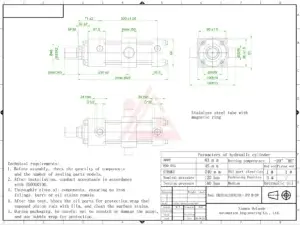
After submitting your specifications, the manufacturer will provide a dimensional drawing. Check all dimensions: bore, stroke, mount location, port position, rod length, and sensor placement. Approve the drawing in writing. A custom tie rod cylinder built from an accurate drawing will fit perfectly and perform reliably.
Conclusion
Specifying a custom Tie Rod Hydraulic Cylinder requires defining bore size, rod diameter, stroke, mounting style, port size, rod coating, seal material, sensors, special threads, operating conditions, and drawing approval. Whether you need a heavy duty tie rod cylinder, long stroke tie rod cylinder, stainless steel tie rod cylinder, high pressure tie rod cylinder, double acting tie rod cylinder, or precision tie rod cylinder, a clear specification ensures you get exactly what your project demands. For foundational knowledge, revisit What Is a Tie Rod Hydraulic Cylinder?. Investing time in specification prevents costly mismatches and downtime.